 Skip to content
In heating elements, the insulation material must perform two seemingly opposite functions: it must prevent electrical current from reaching the metal sheath while allowing heat to transfer efficiently from the resistance wire to the outside.
Magnesium oxide (MgO) is widely used for this purpose in tubular heating elements, cartridge heaters, immersion heaters, and mineral-insulated cables. When properly selected and compacted, electrical grade MgO provides high electrical resistance, good thermal conductivity, and excellent high-temperature stability.
The reason MgO works so well comes from its crystal structure. It restricts the movement of free electrons, providing electrical insulation, while thermal energy can still travel through lattice vibrations. This combination makes MgO particularly suitable for high-temperature electrical heating applications.

Why Is Magnesium Oxide Used as an Electrical Insulator?
Magnesium oxide is used as an electrical insulator because it has very high electrical resistivity, good thermal conductivity, and strong resistance to high temperatures.
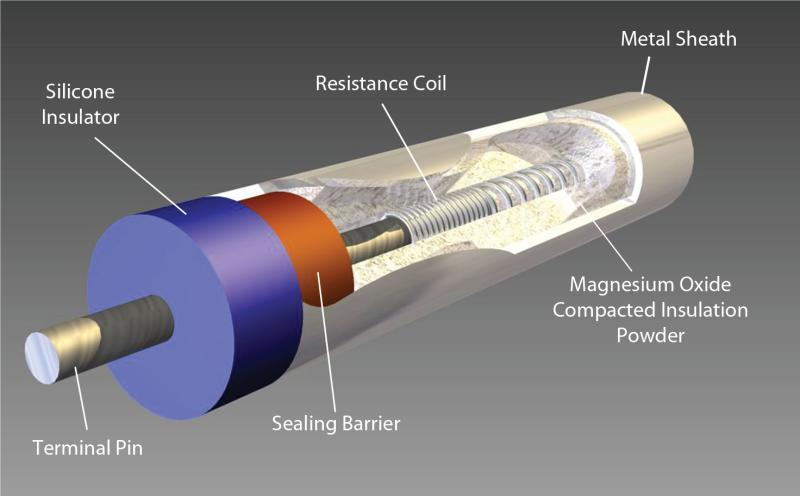
Inside a typical heating element, an electrical current passes through a resistance wire to generate heat. The wire must remain electrically isolated from the surrounding metal sheath to prevent current leakage and electrical failure.
At the same time, the generated heat needs to move efficiently through the insulation and sheath. MgO provides both functions in a single material.
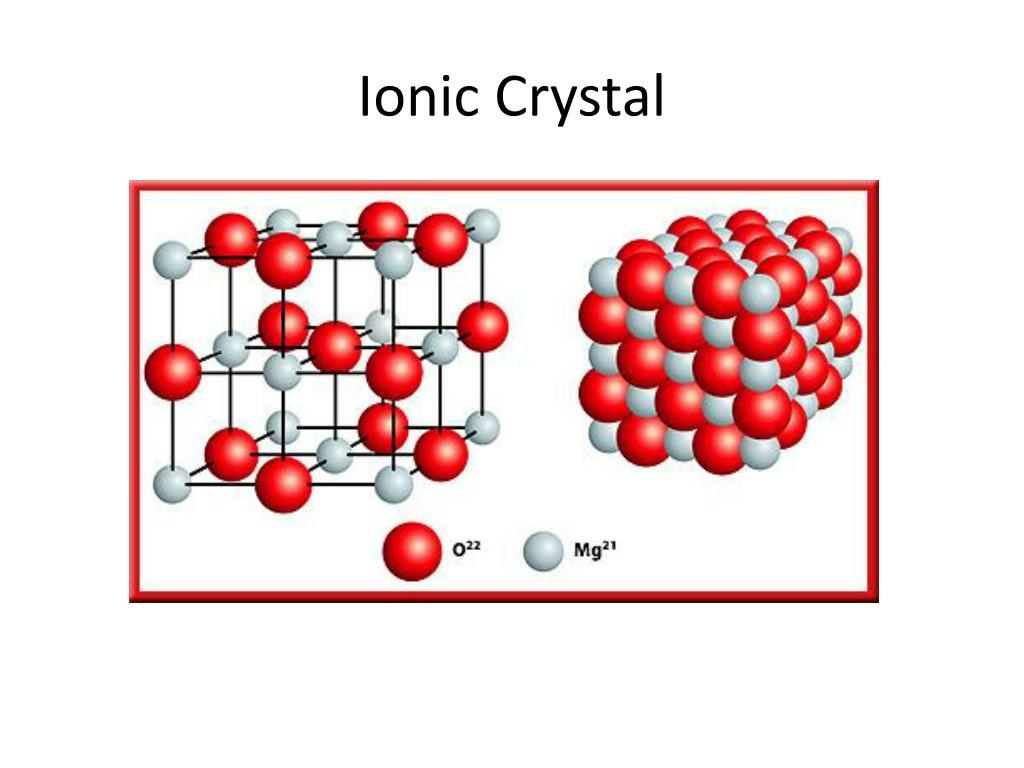
Its ionic crystal structure makes it difficult for electrons to move freely through the material. As a result, MgO has high electrical resistance under normal operating conditions and acts as an effective barrier between the resistance wire and metal sheath.
How Does MgO Provide Electrical Insulation?
MgO is an ionic compound consisting of magnesium and oxygen ions arranged in a stable crystal lattice.
It has a wide electronic bandgap, commonly reported at approximately 7.8 eV. Because electrons are strongly bound within the crystal structure, there are very few freely mobile electrons available to carry electrical current under normal conditions.
This gives MgO its high electrical resistivity.
However, MgO should not be considered a perfect insulator whose resistance remains constant at all temperatures. Electrical resistivity decreases as temperature increases, and moisture can also significantly reduce insulation resistance.
For this reason, heating element manufacturers need to consider operating temperature, moisture content, MgO purity, compaction density, and applied voltage when evaluating insulation performance.
Why Can MgO Insulate Electricity but Conduct Heat?
The most important characteristic of MgO is that electrical insulation and thermal conductivity occur through different physical mechanisms.
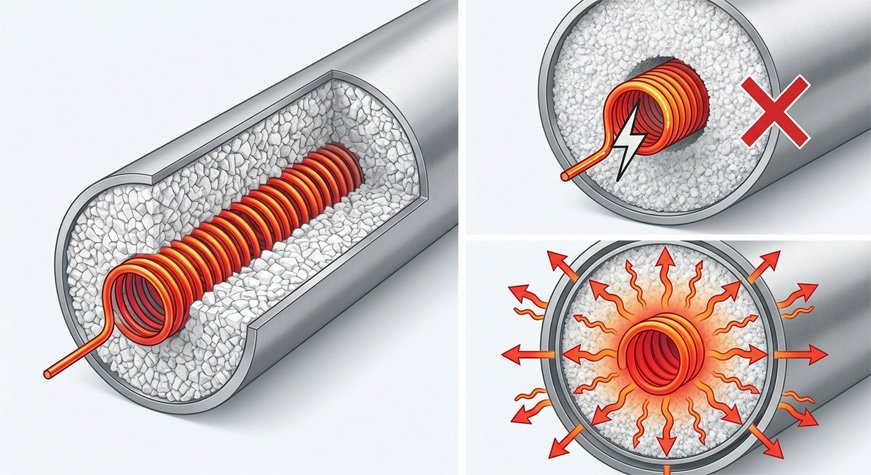
Electrical conduction requires mobile charge carriers. MgO has very few of these under normal conditions, so electrical current cannot easily pass through the material.
Heat transfer does not require free electrons. In crystalline materials such as MgO, thermal energy can be transferred through vibrations of the crystal lattice, commonly described as phonons.
Therefore, MgO can prevent electrical current from passing through the insulation layer while still allowing heat generated by the resistance wire to move toward the metal sheath.
This combination is particularly valuable in electric heating elements, where electrical isolation and efficient heat transfer are both essential.
Why Is MgO Used Inside Heating Elements?
In a typical tubular heating element, a resistance wire is positioned inside a metal sheath and surrounded by MgO powder.
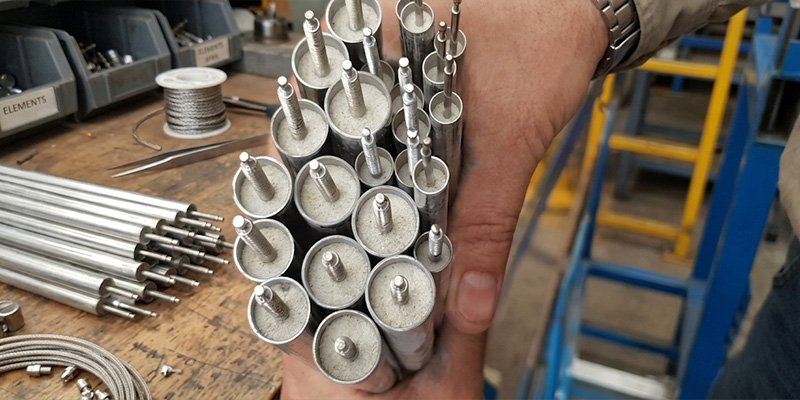
The MgO is filled around the resistance wire and then compacted through processes such as swaging or rolling. This produces a dense insulation layer that electrically separates the wire from the sheath while providing a thermal path for heat transfer.
Compaction is important because loose powder contains air gaps that can reduce thermal transfer and affect insulation performance. Higher and more uniform density helps create better contact between MgO particles and reduces internal voids.
The compacted MgO also supports the resistance wire mechanically, allowing the finished heating element to be bent into different shapes without losing the insulation system.
This manufacturing flexibility is one of the main reasons MgO powder is widely used instead of rigid ceramic insulation components.
Why Is Electrical Grade MgO Different from Ordinary MgO?
Not all magnesium oxide powders are suitable for electrical insulation.
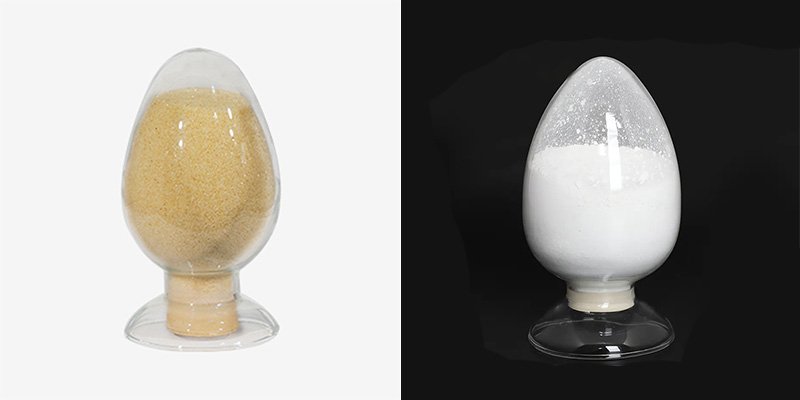
Electrical grade MgO is processed for applications where electrical resistivity, thermal transfer, and high-temperature performance are critical. Chemical impurities must be carefully controlled because certain impurities can increase electrical leakage, particularly at elevated temperatures.
This differs from refractory-grade MgO, which is mainly selected for applications such as furnace linings where high-temperature and chemical resistance are the primary requirements.
For heating element manufacturers, MgO should therefore be evaluated based on more than its nominal purity. Particle size distribution, moisture content, bulk density, flowability, and compaction behavior can all influence the performance of the finished heating element.
Why Does Moisture Affect MgO Insulation?
Moisture is one of the main factors that can reduce the insulation resistance of MgO.
MgO can react with water to form magnesium hydroxide, while moisture also promotes ionic conduction through the insulation. As a result, a heating element exposed to humid conditions can show significantly lower insulation resistance.
This is particularly important during storage and transportation. Even a heater that leaves the factory with excellent insulation resistance can absorb moisture if its terminal area is not adequately sealed.
Proper end sealing, storage conditions, and drying procedures are therefore important for maintaining MgO insulation performance.
How Does MgO Quality Affect Heating Element Performance?
The performance of MgO inside a heating element depends on both its material properties and how it is processed.
High impurity levels can reduce electrical resistivity at elevated temperatures. Excessive moisture can cause insulation resistance to fall. Poor particle size distribution can affect filling and compaction, while insufficient density can increase thermal resistance and contribute to localized overheating.
For high-temperature or high-watt-density heating elements, these factors become especially important because the resistance wire operates under greater thermal stress.
This is why heating element manufacturers should evaluate MgO according to the complete application rather than selecting a material based only on its MgO percentage.
Important parameters may include:
- MgO purity and impurity levels
- Moisture content
- Particle size distribution
- Bulk density
- Flowability
- Compaction behavior
- High-temperature electrical resistance
Frequently Asked Questions
Why is MgO used in tubular heating elements?
MgO provides electrical insulation between the resistance wire and metal sheath while allowing heat to transfer efficiently through the insulation. It can also be compacted around the wire, making it suitable for manufacturing bendable tubular heating elements.
Does MgO conduct electricity at high temperature?
MgO remains an electrical insulator at high temperature, but its electrical resistivity decreases as temperature increases. The operating temperature therefore needs to be considered when designing the insulation system.
Why does moisture reduce MgO insulation resistance?
Moisture can react with MgO and increase ionic conduction, reducing insulation resistance. Proper sealing and storage are important for preventing moisture contamination.
Is higher MgO purity always better?
High purity is important, but it is not the only factor. Particle size, moisture, density, crystal structure, and compaction behavior can also affect the performance of MgO in a heating element.
What is electrical grade magnesium oxide?
Electrical grade MgO is magnesium oxide processed and controlled specifically for electrical insulation applications. It is commonly used in tubular heaters, cartridge heaters, immersion heaters, and other high-temperature electrical heating systems.
Conclusion
Magnesium oxide is widely used as an electrical insulator in heating elements because it combines high electrical resistivity with good thermal conductivity and high-temperature stability.
Its crystal structure restricts the movement of electrical charge while allowing thermal energy to pass through lattice vibrations. When compacted around a resistance wire, MgO provides electrical isolation, efficient heat transfer, and mechanical support within the metal sheath.
However, the performance of MgO depends on more than chemical purity. Moisture, particle size, density, impurities, and compaction all influence the insulation and thermal performance of the finished heating element.
For heating element manufacturers, selecting the appropriate electrical grade MgO and matching it to the manufacturing process is therefore essential for achieving stable insulation resistance, efficient heat transfer, and reliable heater service life.

