 Skip to content
For industrial engineers and B2B buyers, the reliability of a heating system is non-negotiable. At the heart of most industrial tubular and cartridge heaters lies a critical, yet often misunderstood, material: Magnesium Oxide (MgO). While it is the industry standard for electrical insulation, navigating the thermal conductivity challenges of MgO in heating applications is vital to preventing premature heater failure, ensuring efficient energy transfer, and maintaining production uptime.
This comprehensive guide will unpack the role of MgO, the specific thermal challenges it presents, and how to select the right heating elements for your demanding industrial applications.
The Core Concept: What is MgO and Why is it Used in Heaters?
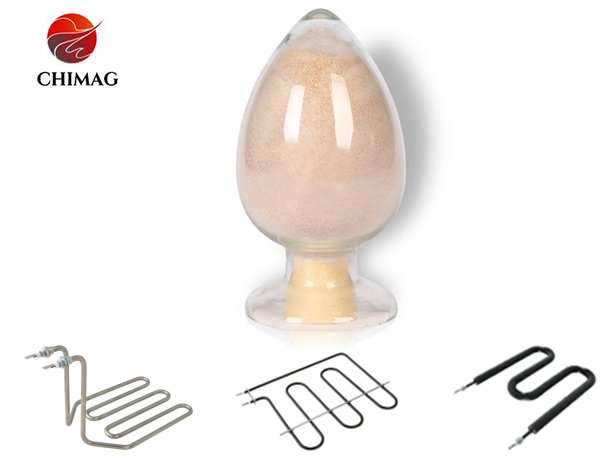
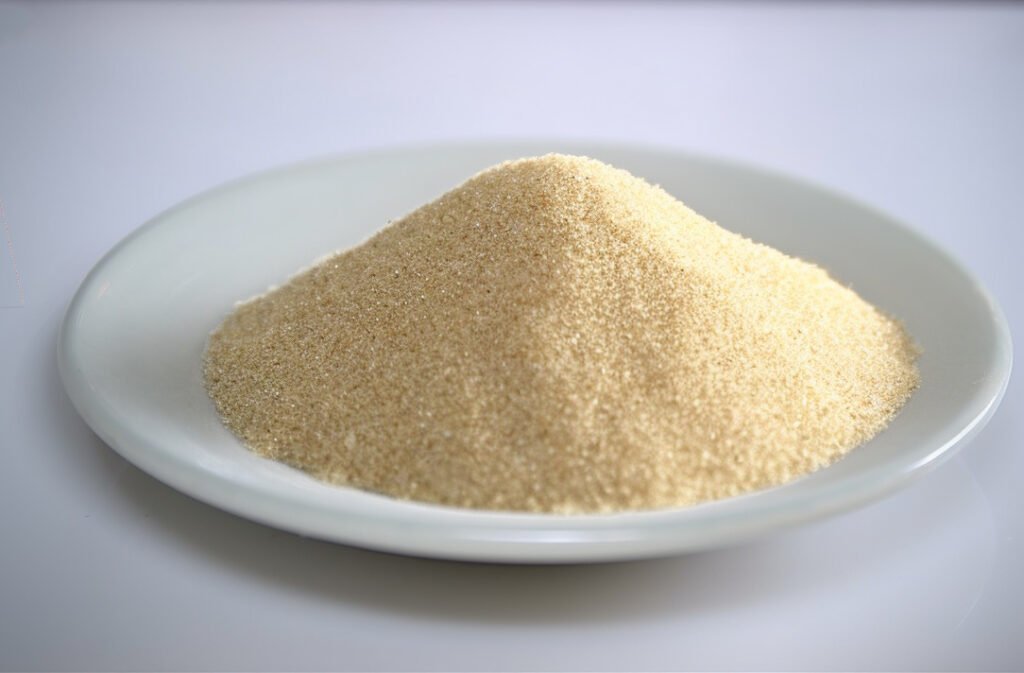
Magnesium Oxide (MgO) is a white, powdery mineral widely used as a dielectric material inside electric heating elements. In a typical tubular or cartridge heater, the resistance wire (like Nichrome) is centered inside a metal sheath, and the space between the wire and the sheath is tightly packed with MgO powder.
MgO serves a highly specific dual purpose:
- Exceptional Electrical Insulator: It prevents the live resistance wire from short-circuiting against the outer metal sheath.
- Thermal Conductor: It transfers the intense heat generated by the resistance wire outward to the sheath and, ultimately, to the target medium.
The Primary Challenge: In its natural, loosely poured state, MgO powder contains microscopic air pockets. Air is a terrible conductor of heat. Therefore, to maximize its thermal conductivity, the MgO must be heavily compacted (swaged or rolled) to eliminate air gaps. Additionally, MgO is highly hygroscopic (it absorbs moisture from the air), which drastically ruins its electrical insulation properties and creates safety hazards.
MgO vs. Alternative Insulating Materials: A Comparative Analysis
When designing high-performance heating elements, engineers sometimes consider alternatives to MgO. Here is how MgO stacks up against other common ceramic and insulating materials in the market.
| Material | Thermal Conductivity | Electrical Insulation | Moisture Sensitivity | Cost | Best Application Scenarios |
|---|---|---|---|---|---|
| High-Purity MgO | Good to Excellent (when highly compacted) | Excellent | High (requires hermetic sealing) | Moderate | Industrial tubular heaters, high-watt-density cartridge heaters. |
| Alumina ($Al_2O_3$) | Moderate | Good | Low | Low to Moderate | Open coil heaters, high-temperature ceramic band heaters. |
| Boron Nitride (BN) | Superior (Excellent heat transfer) | Excellent | Low | Very High | Aerospace, ultra-precision medical heating, highly specialized environments. |
| Mica | Low | Good | Low | Low | Strip heaters, flat heating applications, low-temperature uses. |
While Boron Nitride offers superior thermal conductivity, its exorbitant cost makes it unviable for large-scale industrial use. High-purity MgO remains the ultimate balance of cost, performance, and scalability, provided the manufacturing process properly addresses its thermal and moisture challenges.
Core Application Scenarios: Where MgO Performance Matters Most
The efficiency of MgO directly impacts the performance of equipment across various heavy industries. At elekheat, our MgO-optimized heaters are heavily utilized in the following critical sectors:
1. Injection Mold Heating
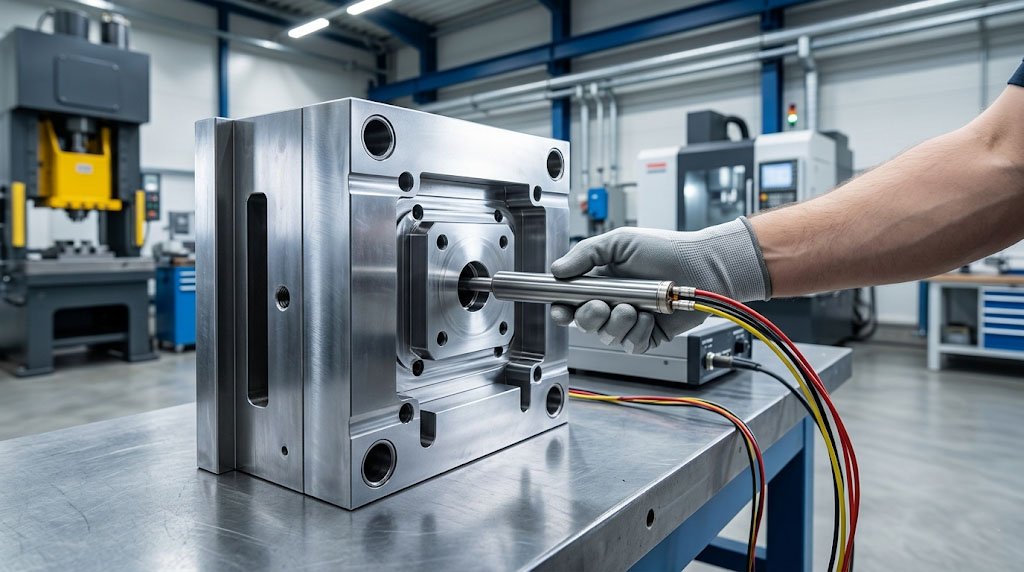
In plastic injection molding, high-watt-density cartridge heaters are inserted deep into metal molds. The heating elements must quickly and evenly transfer heat to keep the plastic resin flowing. If the MgO inside the heater is poorly compacted, the internal core temperature will spike, leading to rapid wire burnout and costly machine downtime. High-grade, densely packed MgO ensures rapid thermal transfer to the mold.
2. Industrial Gas Heating
Circulation heaters used for gas heating require precise temperature control to heat flowing gases safely. Because gases have poor thermal conductivity, the heater’s sheath must transfer heat instantly. Superior MgO thermal conductivity ensures the heating element doesn’t overheat internally while trying to raise the temperature of the fast-flowing gas, preventing element degradation.
Overcoming MgO Challenges: A Selection Guide for Engineers and Buyers
To ensure you are sourcing heating elements that will not fail due to thermal conductivity issues, consider these crucial factors during procurement:
- Specify MgO Purity Levels: Not all MgO is created equal. Commercial-grade MgO may contain impurities (like iron or carbon) that degrade electrical insulation at high temperatures. Always request high-purity MgO (99%+) for high-temperature or high-watt-density applications.
- Verify the Compaction Density: Ask your manufacturer about their swaging or rolling process. The heater should undergo a rigorous reduction process to compress the MgO powder into a rock-solid state, completely eliminating insulating air pockets.
- Demand Superior End-Sealing: Because MgO is highly hygroscopic, moisture ingress is its biggest enemy. Ensure the manufacturer uses robust sealing materials (like epoxy, silicone, or glass-to-metal seals) appropriate for your operating environment to keep moisture out during shipping, storage, and operation.
- Match Watt Density to the Application: Avoid over-specifying watt density. Even with perfect MgO thermal conductivity, pushing too much power into a small area without adequate heat sink conditions will cause premature failure.
Maintenance and Care: Extending the Lifespan of Your Heaters
Even the highest-quality MgO heaters require proper handling. Implement these maintenance strategies to protect your investment:
- The "Soft Start" Bake-Out: If a heater has been stored for a long time, moisture may have bypassed the seals. Apply a low voltage (e.g., 50% of the rated voltage) for 15-30 minutes to gently "bake out" any trapped moisture before applying full power.
- Proper Storage: Store spare heating elements in a dry, climate-controlled environment. Consider keeping them in sealed bags with desiccant packets until they are ready for installation.
- Regular Megger Testing: Periodically use a megohmmeter to test the insulation resistance of your heaters. A sudden drop in insulation resistance is a primary indicator that moisture has compromised the MgO.
Frequently Asked Questions (FAQ)
Q: Why does poor MgO compaction cause heater failure?
A: Poor compaction leaves microscopic air gaps inside the heater. Because air does not conduct heat well, the heat cannot escape the resistance wire fast enough. This causes the internal temperature to skyrocket, melting the wire and causing a catastrophic heater failure.
Q: Does moisture permanently ruin the thermal conductivity of MgO?
A: Moisture primarily ruins the electrical insulation of MgO, causing the heater to short to ground. If caught early, moisture can often be baked out using a low-voltage soft start, restoring the heater’s safe operating parameters.
Q: What is the maximum operating temperature of MgO in heating elements?
A: High-purity MgO can withstand internal temperatures exceeding 1,200°C (2,192°F), making it highly suitable for intense industrial applications, provided the outer metal sheath material can also withstand those temperatures.
Q: How do I know if my manufacturer is using good quality MgO?
A: Reputable manufacturers will provide transparency regarding their raw material sourcing, offer high-purity options, and have strict quality control data showing high insulation resistance (Megohm) test results prior to shipping.
