 Skip to content
Tubular heating elements are widely used in household appliances, industrial heating equipment, chemical processing, and many other fields. Their service life directly impacts equipment safety and operating costs.
Among all the materials that make up a tubular heating element, electrical grade magnesium oxide powder (MgO powder)—as the core insulating and thermally conductive material—plays a decisive role in determining element longevity.
So, how exactly does electrical grade magnesium oxide powder quality affect tubular heating element service life? And what key indicators should you look for when sourcing?
This article breaks it all down.

1. Chemical Composition & Purity: The "Invisible Killer" of Impurities
The chemical purity of electrical grade magnesium oxide powder is the foremost factor affecting tubular heating element service life.
Higher purity means fewer impurities, resulting in better stability and longer service life.
Fe₂O₃ (Iron Oxide) — The Most Critical Impurity Control Parameter
The lower the content, the better.
High Fe₂O₃ content directly undermines the long-term stability of the tubular heating element and shortens its service life.
Loss on Ignition (LOI)
Loss on Ignition (LOI) primarily refers to the moisture and volatile content in MgO powder.
Excessive moisture vaporizes at high temperatures, potentially causing:
- Internal pressure increase
- Sheath deformation
- Tubular heating element failure
Boron (B)
Boron affects the sintering behavior of magnesium oxide powder.
During the annealing process (1050–1080°C), high boron content may cause the MgO powder to sinter prematurely, leading to:
- Cracks during bending
- Reduced voltage withstand capability
- Degraded insulation performance
Sulfur (S) & Phosphorus (P)
These impurities shorten the service life of the resistance wire itself, causing:
- Premature aging
- Resistance wire fracture
- Reduced heating element reliability
Carbon (C)
Excessive carbon content (≥100 PPM) leads to:
- Increased leakage current
- Reduced voltage withstand capability
- Degraded insulation performance of the MgO insulation layer
CaO (Calcium Oxide)
Commonly known as lime, CaO readily absorbs moisture to form Ca(OH)₂.
This aggravates the hygroscopic problem of electrical grade MgO powder and further damages insulation performance.
Magnetic Materials
Magnetic impurities are harmful and must be strictly controlled.
Industry benchmarks require magnetic impurity levels ≤50 PPM.
Excessive magnetic impurities directly affect voltage withstand performance, causing:
- Electrical property degradation
- Reduced insulation reliability
- Shortened tubular heating element life
MgO Content
Fused magnesium oxide typically has an MgO content between 96% and 98%.
Higher MgO content means:
- Fewer impurities
- Better thermal stability
- Improved insulation performance
For high-quality electrical grade magnesium oxide powder, MgO content should be ≥96%.
2. Particle Size Distribution (PSD): Getting the "Grain" Right
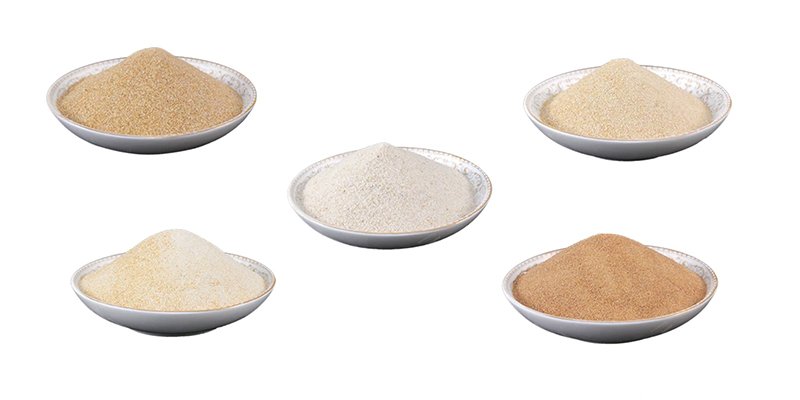
The particle size distribution (PSD) of MgO powder must be carefully controlled.
Both excessively fine and excessively coarse particles can cause serious problems.

Too Fine (Large Mesh Number)
Fine MgO powder has a larger specific surface area, making it highly susceptible to moisture absorption from the air.
This may result in:
- Reduced insulation performance
- Increased moisture sensitivity
- Shortened tubular heating element service life
Fine powder can also create significant dust issues during the filling process.
Too Coarse (Small Mesh Number)
Coarse MgO particles can damage the resistance wire surface during the swaging (tube reduction) process.
They may also cause:
- Resistance wire misalignment
- Loose winding
- Voids in the heating coil area during MgO filling
Best Practice
The appropriate particle size distribution (PSD) should be selected according to:
- Tubular heating element diameter
- Resistance wire pitch
- Manufacturing process
Recommended selection:
| Tubular Heating Element Diameter | Recommended MgO Particle Size |
|---|---|
| ≥8 mm | 40–325 mesh |
| 6.5–8 mm | 50–325 mesh |
| ≤6.5 mm | 60–325 mesh |
Blending different mesh sizes in specific proportions can effectively increase powder density and improve filling performance.
Industry Standard
Particle size distribution is typically determined by sieve analysis methods.
ASTM D2772 is the internationally recognized standard test method for electrical grade magnesium oxide powder particle size analysis.
3. Compacted Density & Thermal Conductivity: The "Highway" for Heat
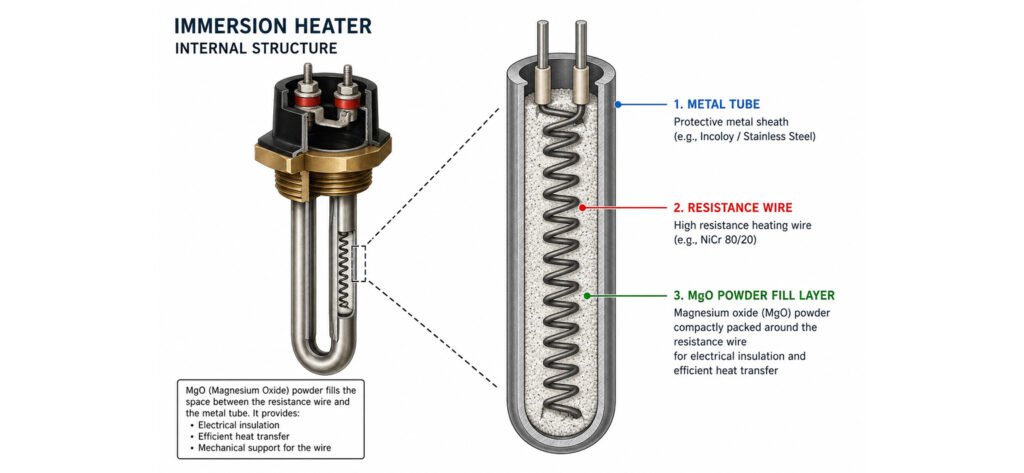
Compacted density of electrical grade magnesium oxide powder directly affects heat dissipation and thermal transfer efficiency of the tubular heating element.
MgO powder performs two critical functions:
- Electrically insulating the resistance wire from the metal sheath
- Transferring heat efficiently from the resistance wire to the outer sheath
Insufficient Compacted Density
Large gaps between MgO powder particles reduce heat transfer efficiency.
Heat may accumulate around the resistance wire, causing:
- Local overheating
- Accelerated oxidation
- Reduced heating element lifetime
- Premature burnout
Excessive or Insufficient Density
Both conditions can negatively affect performance.
Excessive density:
- Makes bending more difficult
- Increases internal stress
- May cause cracking
Insufficient density:
- Creates poor filling quality
- Produces internal voids
- Reduces voltage withstand capability
- Causes electrical performance failure
Density Requirements
Typical MgO powder compacted density requirements:
| Application | Compacted Density |
|---|---|
| Aluminum and copper tube heating elements | 2.36–2.40 g/cm³ |
| Bundy tubes and stainless steel tubular heating elements | 2.31 ± 0.03 g/cm³ |
Test Methods
Compacted density is measured according to:
ASTM D2755 – Standard Test Method for Compacted Density of Electrical Grade Magnesium Oxide
Flow rate and tap density are determined by:
ASTM D3347 – Standard Test Method for Determination of Flow Rate and Tap Density of Electrical Grade Magnesium Oxide
4. Moisture Resistance: The "Lifeline" of MgO Insulation
Moisture resistance is a major challenge for electrical grade magnesium oxide powder.
MgO powder is naturally hygroscopic and readily absorbs moisture from the air, forming magnesium hydroxide:
MgO + H₂O → Mg(OH)₂
Moisture absorption causes insulation performance to decrease significantly.
Possible failures include:
- Increased leakage current
- Reduced insulation resistance
- Failure to heat
- Complete electrical breakdown
Moisture Protection Treatment
During tubular heating element manufacturing, moisture removal (baking) is essential.
Surface treatment technologies, such as silicone oil treatment, may improve moisture resistance.
This is particularly important for:
- Humid environments
- Tropical regions
- Long-distance transportation
Modifier Addition
Modifiers can improve moisture resistance, but the amount must be carefully controlled.
Excessive modifiers may:
- Reduce maximum operating temperature
- Affect thermal conductivity
- Change sintering characteristics
- Increase failure risks
5. High Temperature Stability: The "Touchstone" of High Heat
Different operating temperatures require different grades of electrical grade MgO powder.
If the MgO grade is unsuitable, insulation performance may deteriorate, resulting in:
- Leakage current increase
- Reduced insulation resistance
- Short circuits
- Heating element failure
Annealing Process Requirements
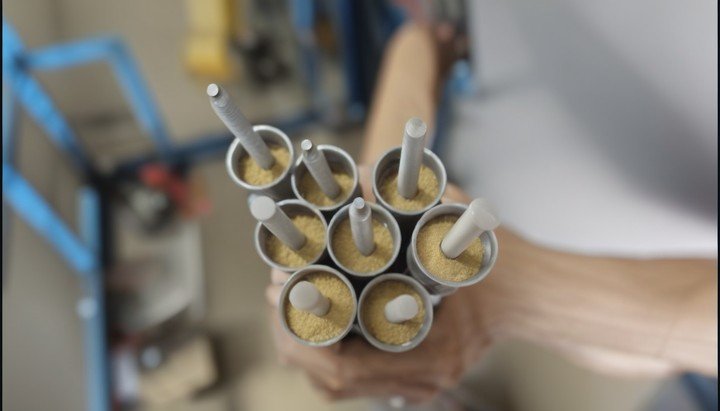
High-temperature tubular heating elements typically undergo annealing at:
1050–1080°C for 15–40 minutes
During this process, MgO powder must maintain:
- Structural stability
- Proper sintering behavior
- Good insulation performance
Poor-quality MgO powder may:
- Sinter unevenly
- Develop cracks
- Lose insulation capability
MgO Temperature Classification
| MgO Grade | Operating Temperature |
|---|---|
| Low-temperature MgO | T ≤ 400°C |
| Medium-temperature MgO | 400°C < T ≤ 600°C |
| High-temperature MgO | 600°C < T ≤ 850°C |
Test Methods
Sintering characteristics are evaluated using:
ASTM D3026 – Standard Test Method for Sinter Index of Electrical Grade Magnesium Oxide
Accelerated life testing:
ASTM D2900 – Standard Test Method for Accelerated Life Test of Electrical Grade Magnesium Oxide
6. Electrical Properties: The Core Performance Indicator
The electrical properties of electrical grade magnesium oxide powder are fundamental indicators of insulation quality.
The specific electrical impedance of MgO powder directly determines insulation reliability.
Specific Electrical Impedance Test
ASTM D3215 – Standard Test Method for Measurement of the Specific Electrical Impedance of Electrical-Grade Magnesium Oxide for Use in Sheathed-Type Heating Elements
is the internationally recognized testing method.
Thermal Conductivity
Thermal conductivity determines heat transfer efficiency from the resistance wire to the outer metal sheath.
Good thermal conductivity helps:
- Reduce overheating
- Improve heating efficiency
- Extend tubular heating element service life
Testing method:
ASTM D2858 – Standard Test Method for Thermal Conductivity of Compacted, Granular Electrical Grade Magnesium Oxide
Summary & Recommendations
The quality of electrical grade magnesium oxide powder affects tubular heating element service life through multiple factors:
Chemical Purity
Key indicators:
- MgO content
- Fe₂O₃ content
- Boron impurities
- Carbon content
- Sulfur and phosphorus impurities
- Magnetic impurity levels
Particle Size Distribution (PSD)
Proper PSD improves:
- Filling performance
- Compacted density
- Heat transfer efficiency
- Insulation reliability
Compacted Density
Proper MgO powder compaction ensures:
- Stable heat transfer
- Reliable insulation performance
- Reduced overheating risk
Moisture Resistance
Moisture-resistant MgO powder helps prevent:
- Leakage current
- Insulation degradation
- Premature tubular heating element failure
High Temperature Stability
The MgO powder grade must match the operating temperature requirements of the tubular heating element.
Electrical Performance
Specific electrical impedance and thermal conductivity are key indicators of MgO powder quality.
Recommendations for Buyers
Choose High-Purity Electrical Grade MgO Powder
Look for:
- MgO content ≥96%
- Low Fe₂O₃ content
- Controlled boron content
- Low magnetic impurities
Match Particle Size Distribution to Application
Select MgO powder according to:
- Tubular heating element diameter
- Resistance wire design
- Manufacturing process
Prioritize Moisture-Resistant MgO Grades
For humid environments or long shipping routes, choose MgO powder with suitable moisture protection treatment.
Verify Against International Standards
Ensure suppliers provide testing data according to:
| Standard | Test Item |
|---|---|
| ASTM D2772 | Sieve Analysis |
| ASTM D2755 | Compacted Density |
| ASTM D3347 | Flow Rate and Tap Density |
| ASTM D3026 | Sinter Index |
| ASTM D3215 | Specific Electrical Impedance |
| ASTM D2900 | Accelerated Life Test |
Final Conclusion
Electrical grade magnesium oxide powder is not simply a filling material inside a tubular heating element.
It is a critical functional material that determines:
- Insulation reliability
- Heat transfer efficiency
- Long-term service life
Selecting the correct MgO powder for tubular heating elements can significantly reduce failures, improve equipment reliability, and lower maintenance costs.
For heating element manufacturers, investing in high-quality electrical grade magnesium oxide powder is one of the most effective ways to improve product performance and customer satisfaction.
