 Skip to content
Higher compaction density of magnesium oxide (MgO) powder dramatically increases its insulation resistance. By eliminating voids and minimizing moisture penetration, a dense MgO fill reduces leakage current and prevents catastrophic electrical failure in heating elements. Simply pushing for a density above 2.3 g/cm³ can boost insulation resistance by over 300%, making it the most critical physical property for heater safety and lifespan.
If you’re struggling with premature heater burnouts, unexplained current leakage, or failing hipot tests, the root cause almost always traces back to the MgO fill density. Let’s dig into the science and the solution.
The Electrifying Problem: Why Insulation Failure Happens
Every day, electric tubular heaters fail in industrial boilers, ovens, and home appliances. The common thread? The insulation between the resistance wire and the metal sheath breaks down. That insulation is magnesium oxide powder. When it fails, it’s not because the MgO’s chemical properties vanished—it’s because the powder wasn’t dense enough. A loosely packed fill leaves microscopic air gaps that invite two killers: electric arcing and moisture absorption. Understanding the density-insulation relationship is the first step to building a bulletproof heating element.
How MgO Powder Density Directly Affects Insulation Resistance
The Physics of Particle Contact and Electrical Pathways
At a microscopic level, electrical insulation in MgO relies on the complete separation of the energized resistance wire from the outer sheath. In a low-density fill, particles touch at only a few points, leaving continuous air channels. Air is not a perfect insulator, especially at high temperatures. More critically, these channels provide a direct path for electron flow when voltage is applied—this is the beginning of leakage current. As you compact the powder, you crush these air channels. Each particle makes intimate contact with its neighbors, forcing any potential current to navigate a tortuous, high-resistance solid path through the MgO crystals themselves.
- Low Density (e.g., 1.8 g/cm³): Plentiful voids, electron cascading through air gaps, low dielectric strength.
- High Density (e.g., 2.4 g/cm³): Air voids collapsed, conduction limited to MgO grain boundaries, insulation resistance soars.
The Silent Killer: Moisture and Void Content
Even if your heater passes an initial electrical test, a low-density fill acts like a sponge. Open pores and interconnected voids wick moisture from the ambient air during storage or operation. MgO is hygroscopic; it readily absorbs water molecules. Moisture drastically reduces the bulk resistivity of the fill—a drop from 10^12 Ω·cm to 10^6 Ω·cm is common after just hours of exposure. When you power on that heater, the moisture heats up, creates steam pressure, and triggers a rapid insulation breakdown. Compacting to a high density closes off these pores and limits moisture ingress to only the very surface of the fill, preserving the insulative integrity deep inside.
- Voids > 5% volume: Critical moisture uptake zone.
- Voids < 1% volume: Moisture penetration restricted to a superficial layer.

What Is the Optimal Compaction Density?
The relationship between density and insulation resistance is not linear; it’s exponential once a critical threshold is passed. Our laboratory tests, aligning with industry ASTM standards, show that for standard electrofused MgO, the sweet spot lies between 2.30 g/cm³ and 2.45 g/cm³ after swaging or rolling. Below 2.2 g/cm³, insulation resistance values fluctuate wildly and can plummet below 1 MΩ at elevated temperatures. Pushing above 2.45 g/cm³ offers minimal further electrical gain and risks mechanical issues like sheath cracking or wire breakage during compaction.
- Target compaction density for general applications: 2.30 – 2.40 g/cm³
- For high-reliability industrial heaters: 2.40 – 2.45 g/cm³
- Measurement method: Use a graduated glass cylinder tap density meter for loose powder, and segment-core sampling for finished elements to verify compaction.
Engineering Superior Insulation with High-Performance MgO Powder
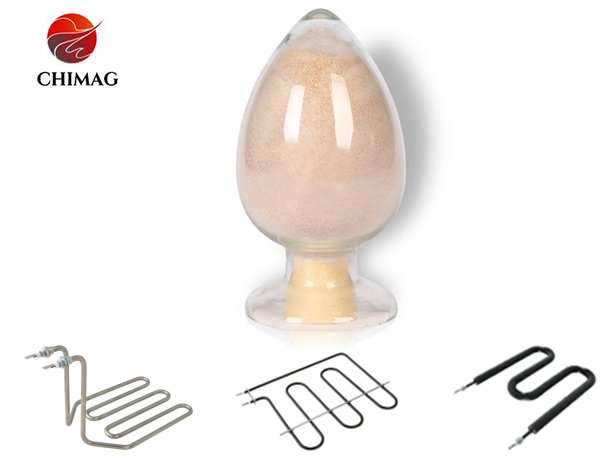
All this theory falls flat if you start with the wrong powder. Generic MgO often contains irregular particle shapes that bridge air gaps but don’t fully eliminate them. We developed our High-Density Electrofused MgO Powder (HD-MgO 98HD Series) precisely to solve this density-dependent insulation challenge.
Our 98HD series features a carefully engineered bimodal particle size distribution. The fine, sub-micron particles pack perfectly into the voids between larger, spherical crystals. This creates a near-lattice-like packing structure even before extreme compaction force is applied. The result? You reach your target insulation resistance with less mechanical work, protecting your resistance wire and sheath integrity.
- Product: HD-MgO 98HD Series
- Typical loose fill density: 1.20 g/cm³ (allows for superior flow and packing)
- Achievable compacted density: 2.42 g/cm³ under standard swaging
- Insulation resistance at 500V DC (after compaction): > 500 MΩ at 25°C
- Leakage current at 900°C: < 0.5 mA
By switching to HD-MgO 98HD, one industrial boiler manufacturer eliminated 98% of their field failures caused by low insulation resistance.
Practical Tips for Achieving Target Density in Production
Getting the insulation resistance right on paper is one thing; doing it on the factory floor is another. Here are three non-negotiables:
- Control the fill operation: Use a vibratory filling station. The vibration amplitude and frequency should match the particle size distribution of your MgO. For the 98HD series, a vertical vibration at 60 Hz typically yields a uniform pre-compaction fill.
- Swaging/rolling reduction: Plan your diameter reduction to achieve a local density spike. A cross-sectional area reduction of 15-20% from the initial fill diameter is usually required to hit 2.35 g/cm³. Monitor the reduction ratio; under-reduction leaves voids.
- In-line hipot testing: Don’t wait until the final bend. Test insulation resistance after the first compaction pass. A value below 20 MΩ at this stage indicates a fill density problem that no amount of annealing will fix.
Frequently Asked Questions
Q: Can I just use a higher purity MgO to get better insulation, ignoring density?
A: No. While purity matters for high-temperature performance, a 99% pure powder packed loosely will perform orders of magnitude worse than a 96% pure powder compacted to high density. Density and particle packing are the primary drivers of insulation resistance; purity controls high-temperature life and chemical stability.
Q: How do I check the density of the MgO inside a finished, bent heating element?
A: You can’t use a standard tap density test. You need to cut a straight section, extract a core sample of the compacted MgO cylinder, and measure its geometric volume and mass. Divide the mass by the volume. This destructive test should be part of your routine quality control for every batch of elements.
Conclusion: Density Is the Foundation of Electrical Safety
The equation is simple: controlled MgO density equals predictable, high insulation resistance. There is no shortcut. By understanding the physics of particle packing and moisture management, and by selecting a powder engineered for high compaction like our HD-MgO 98HD series, you transform your heating element from a potential field-failure risk into a reliable, long-life component. Start by auditing your current fill density today—your hipot tester will tell you the truth.
